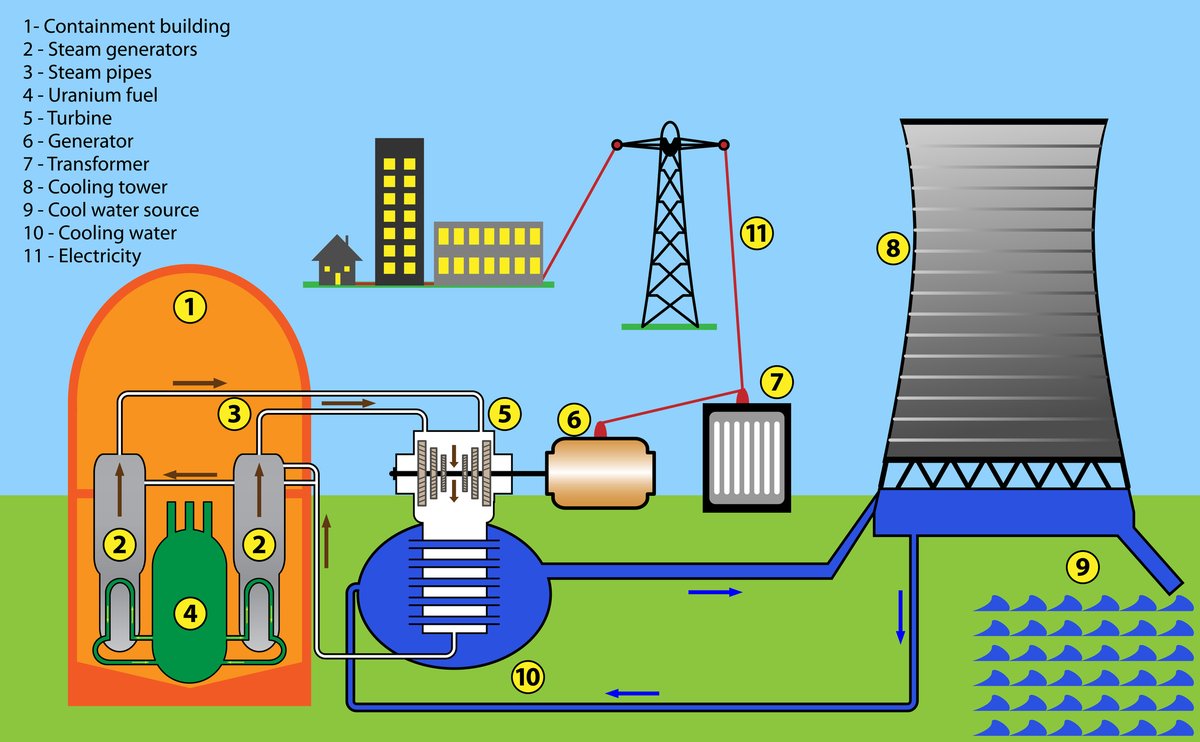
Imagine harnessing the power hidden within a tiny atom to light up entire cities. That's the essence of a nuclear power generator. Far from being a futuristic dream, these sophisticated facilities are working quietly around the clock, providing a significant portion of our world's electricity. While they share similarities with other thermal power plants, their unique method of generating heat from nuclear reactions sets them apart, making them a fascinating and critical part of our energy landscape.
At its core, a nuclear power plant is an elegant dance of physics and engineering, transforming the immense energy locked inside atomic nuclei into the electricity that powers our modern lives. This incredible process boils down to three fundamental steps: first, generating thermal energy from nuclear reactions; second, using that heat to produce steam; and finally, using that steam to spin a turbine and generate electricity.
Unlocking Atomic Energy: The Magic of Nuclear Fission
The journey begins deep within the atom itself, specifically with a process called nuclear fission. This isn't just any chemical reaction; it's a profound alteration of an atom's nucleus. In simple terms, fission involves splitting the nucleus of a heavy atom, most commonly uranium. When a neutron strikes a uranium atom, it causes the atom to break apart, releasing a tremendous amount of heat, along with radioactive materials and more neutrons.
These newly released neutrons can then strike other uranium atoms, causing them to split and release even more neutrons and energy. This creates a self-sustaining chain reaction, a controlled process that continuously generates the thermal energy needed for power production. To truly grasp the atomic mechanics behind this incredible energy release, you'll want to Explore nuclear fission fundamentals.
The Reactor's Heart: Converting Nuclear Heat to Steam
With the principles of fission in play, the next step is to harness that immense heat. This happens within the nuclear reactor, often considered the heart of the power plant. Inside the reactor, nuclear fuel rods, typically packed with uranium pellets, are carefully arranged. As fission occurs, these rods heat up to incredibly high temperatures.
Core Components and Control Mechanisms
The nuclear reactor isn't just a container for fuel; it's a meticulously engineered system designed for safety and efficiency. Within it, alongside the fuel rods, are crucial components like control rods. These rods, often made of materials like cadmium or boron, are designed to absorb neutrons. By raising or lowering them, operators can regulate the rate of the nuclear chain reaction, preventing uncontrolled heat generation (a meltdown) and adjusting the power output based on electricity demand.
To ensure the safety of both the plant and its surroundings, the entire nuclear reactor and its primary water circuit are encased within a massive containment building. This robust structure is designed to withstand extreme conditions, containing any potential explosions and preventing the escape of radioactive materials. Understanding these sophisticated designs is key, so we recommend you Discover essential reactor components. And to understand how this vital fuel is prepared and managed, it's worth taking time to Explore the nuclear fuel cycle Understand its intricacies.
How Water Circuits Transform Heat
Once the nuclear reactions generate intense heat within the reactor, that thermal energy needs to be transferred to create steam. Globally, about 90% of nuclear plants use light water reactors, with Pressurized Water Reactors (PWRs) being the most common type, followed by Boiling Water Reactors (BWRs). Both use water to transfer heat, but they do so in slightly different ways.
In a Pressurized Water Reactor (PWR), there are two distinct, closed water circuits:
- The Primary Circuit: Water in this circuit flows directly through the reactor core. It's kept under extremely high pressure (around 2000 pounds per square inch) to prevent it from boiling, even as it's superheated to very high temperatures by the nuclear reactions. This superheated, pressurized water then flows into a component called a steam generator.
- The Secondary Circuit: Inside the steam generator, the superheated water from the primary circuit transfers its heat to a separate, lower-pressure water system in the secondary circuit. This heat transfer causes the water in the secondary circuit to boil and turn into high-pressure steam.
In contrast, Boiling Water Reactors (BWRs) simplify this by allowing the water directly within the reactor vessel to boil. The steam produced in the reactor core is then directly channeled to drive the turbines. While different in their steam generation, both systems brilliantly convert nuclear energy into thermal energy, then into the internal energy of steam, ready for the next crucial step. To dive deeper into how this heat transfer is managed, check out our Heat exchange and steam guide Understanding.
Spinning Turbines: Generating Electricity for the Grid
Now armed with superheated, high-pressure steam, the power plant is ready for its final transformation: generating electricity. The steam from the steam generators (in PWRs) or directly from the reactor (in BWRs) is directed with incredible force to a large steam turbine.
From Steam to Electric Current
As the high-pressure steam rushes past the turbine's blades, it causes them to spin rapidly. This converts the steam's thermal and kinetic energy into mechanical energy. Attached to the turbine's shaft is an electrical generator – a device that uses electromagnetic induction to convert this rotational mechanical energy into electrical energy. This is the moment the atomic-scale events finally manifest as usable electricity for homes and industries.
After passing through the turbine and giving up much of its energy, the steam is no longer superheated. It then enters a condensation tank, where it comes into thermal contact with pipes carrying cold water from an external source (like a river, lake, or cooling tower). This cold water cools the spent steam, causing it to condense back into liquid water. This condensed water is then pumped back either into the reactor vessel (for BWRs) or into the steam generators (for PWRs) to be heated again, completing the cycle and ensuring continuous operation. To fully appreciate this mechanical marvel, be sure to explore Electricity Generation via Turbines.
A Powerful Future
From the invisible splitting of an atom to the visible glow of a light bulb, the operation of a nuclear power generator is a testament to human ingenuity. It's a complex, multi-stage process that elegantly transforms the raw power of nuclear fission into the reliable, large-scale electricity our world depends on. As we navigate the challenges of energy demand and climate change, understanding how these giants work is more important than ever, paving the way for discussions about a sustainable and energy-secure future.